


Manchester City's Perfect Storm: Analysing the Champions' Challenging Season
Updated: Feb 17, 2025
Manchester City's recent form has raised eyebrows across the football world. The reigning champions have shown uncharacteristic vulnerability this season, and a deep dive into the data reveals a perfect storm of challenges facing Pep Guardiola's side. Let's analyze the key factors contributing to their current struggles.
The Age Structure Crisis

A striking visualisation of City's squad from The Athletic reveals a concerning demographic pattern. The team's age distribution shows very few players in what would traditionally be considered their prime years (24-28). Instead, the squad appears to be split into two distinct groups:
Veterans over 30 (De Bruyne, Gundogan, Walker)
Young talents under 24 (Foden, McAtee, Lewis)
This "missing middle" could be significantly impacting the team's performance. Players in their prime years typically combine physical peak condition with substantial experience – exactly what's needed for the intense, high-pressure style that has defined City's success. The relative lack of players in this crucial age bracket might be affecting the team's ability to maintain their traditionally high-intensity pressing game across full matches.
The Rodri Factor
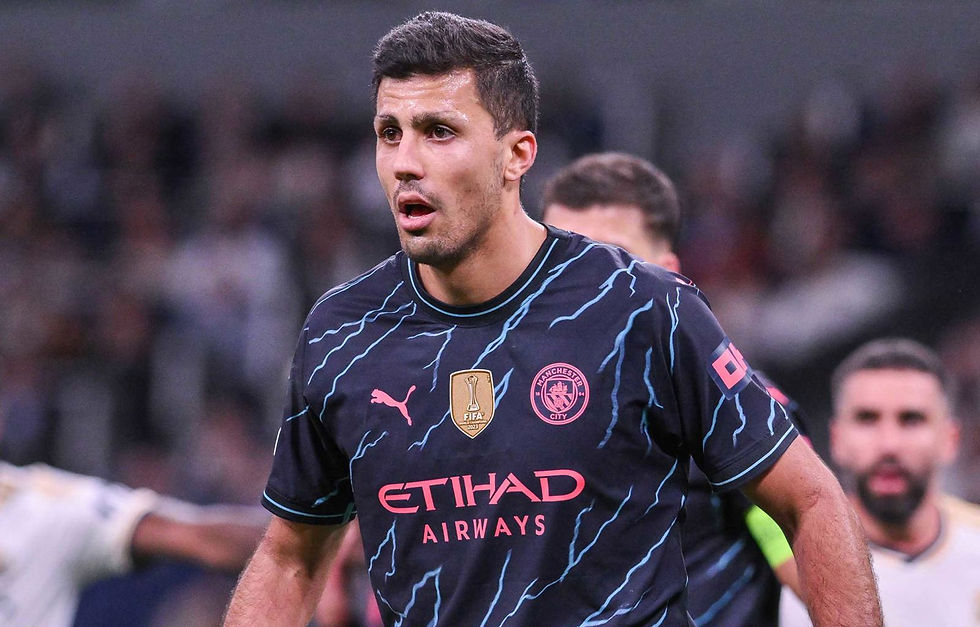
Perhaps no single statistic better illustrates City's challenges than their performance with and without Rodri. The numbers are stark:

Manchester City With vs Without Rodri
These figures demonstrate that Rodri isn't just important to City's system – he's absolutely vital. The Spanish midfielder's absence has coincided with a dramatic drop in both offensive and defensive effectiveness:
Points per game drop from 2.37 to 1.90
Goal difference per game decreases from +1.7 to +1.3
This dependency on a single player highlights a potential structural weakness in the squad. While City has depth in many positions, they lack a like-for-like replacement for Rodri's unique skill set as a defensive midfielder who can both shield the defense and initiate attacks.
The European Hangover Effect
The impact of European competition on City's Premier League performance is perhaps the most revealing insight of all. The statistics paint a clear picture of fatigue's impact:
After European Games:
1.25 points per game
0% away win rate
1.5 goals scored per game
2.0 goals conceded per game
Without European Games:
1.94 points per game
45% away win rate
2.19 goals scored per game
1.19 goals conceded per game

The contrast is striking. City's defensive vulnerability particularly stands out – they concede nearly twice as many goals in league games following European matches. This suggests that the physical and mental demands of competing on multiple fronts are taking a heavier toll than in previous seasons.
The Perfect Storm
What we're witnessing at Manchester City isn't simply bad form – it's the convergence of multiple challenging factors:
A squad age profile that lacks players in their prime years
Over-reliance on key individuals like Rodri
The physical demands of competing in multiple elite competitions
Each of these factors alone would be challenging, but together they create a perfect storm that even a manager of Guardiola's caliber is finding difficult to navigate.
Looking Forward
The data suggests that City's challenges aren't insurmountable, but they do require attention. The January transfer window might offer opportunities to address the squad's age imbalance or provide additional cover for key positions. However, the more immediate challenge will be managing the squad's energy levels through the demanding winter schedule.
For a team that has set such high standards in recent years, this period of adjustment might feel like a crisis. However, the underlying numbers suggest it's more of a transitional phase – one that requires careful management but doesn't necessarily indicate a long-term decline in the team's capabilities.
What's clear is that City's traditional strength in depth is being tested like never before. How Guardiola adapts to these challenges could define not just this season, but the next phase of Manchester City's evolution as a football powerhouse.


Comments